

At what point do we cease to be what we once were?
Sometimes transformation is visible. The body changes, matter shifts, one form becomes another.
At other times, it takes place somewhere far more difficult to locate: in memory, in perception, in what we recognize and suddenly can no longer see in quite the same way.
Taking Franz Kafka's The Metamorphosis as a point of departure, this exhibition explores the unsettling space between recognition and estrangement—where identity becomes unstable, the familiar turns strange, and new forms emerge for which we do not yet have a name.

01 /
The Strange
Strangeness begins when recognition falters.
ALL IMAGES ARE CLICKABLE ↓


What if familiarity were only a habit of seeing?
We recognize the story before we trust the image. A childhood fable, a figure in a landscape: each offers the comfort of a known form, then quietly withdraws it.
In Freud’s das Unheimliche, the uncanny arises not from the wholly foreign, but from the familiar returning as something disturbing. Viktor Shklovsky approached estrangement from another direction: art interrupts the habits that make perception automatic.
Between these distinct ideas, the works gathered here invite a slower, less certain way of looking. Nothing has necessarily changed. Yet nothing looks quite the same.

Before the image settles.
Here, a line is free to become a body, an apparition, or neither. In Mendizábal's sketchbook, drawing preserves the moment before recognition fixes an image in place. Not a record of unfinished ideas, but a work whose openness is central to its meaning.
ALL IMAGES ARE CLICKABLE ↓
02 /
The Monstruous
The monster is never entirely other.
From the hybrid creatures of medieval marginalia to Goya’s unsettling visions, art has long given form to what we fear, desire, or struggle to recognize. As Jeffrey Jerome Cohen suggests, the monster is also a cultural body, shaped by the anxieties and contradictions of its time.
Between attraction and repulsion, recognition and rejection, the monstrous unsettles the categories through which we understand the world. Here, familiar anatomies become unstable, identities resist definition, and something seems to watch us from the darkness. The boundaries between the human and the animal, the beautiful and the grotesque, the self and its imagined opposite begin to dissolve.


When the familiar body comes undone.
A face takes shape through restless lines and dark interruptions, its human likeness continually threatened by distortion. In this fragment of Mendizábal's sketchbook, the monstrous emerges not as an invented creature, but as a disturbance within the very image of ourselves.
What if the monster
is looking back?

03 /
What Mutates
Nothing becomes something else all at once.
ALL IMAGES ARE CLICKABLE ↓



← EXPLORE THE WORKS
Transformation unsettles the comforting distinction between a before and an after. In Ovid’s Metamorphoses, bodies assume unfamiliar forms, yet traces of their former selves persist.
Here, change unfolds through subtle displacements and fractured continuities.
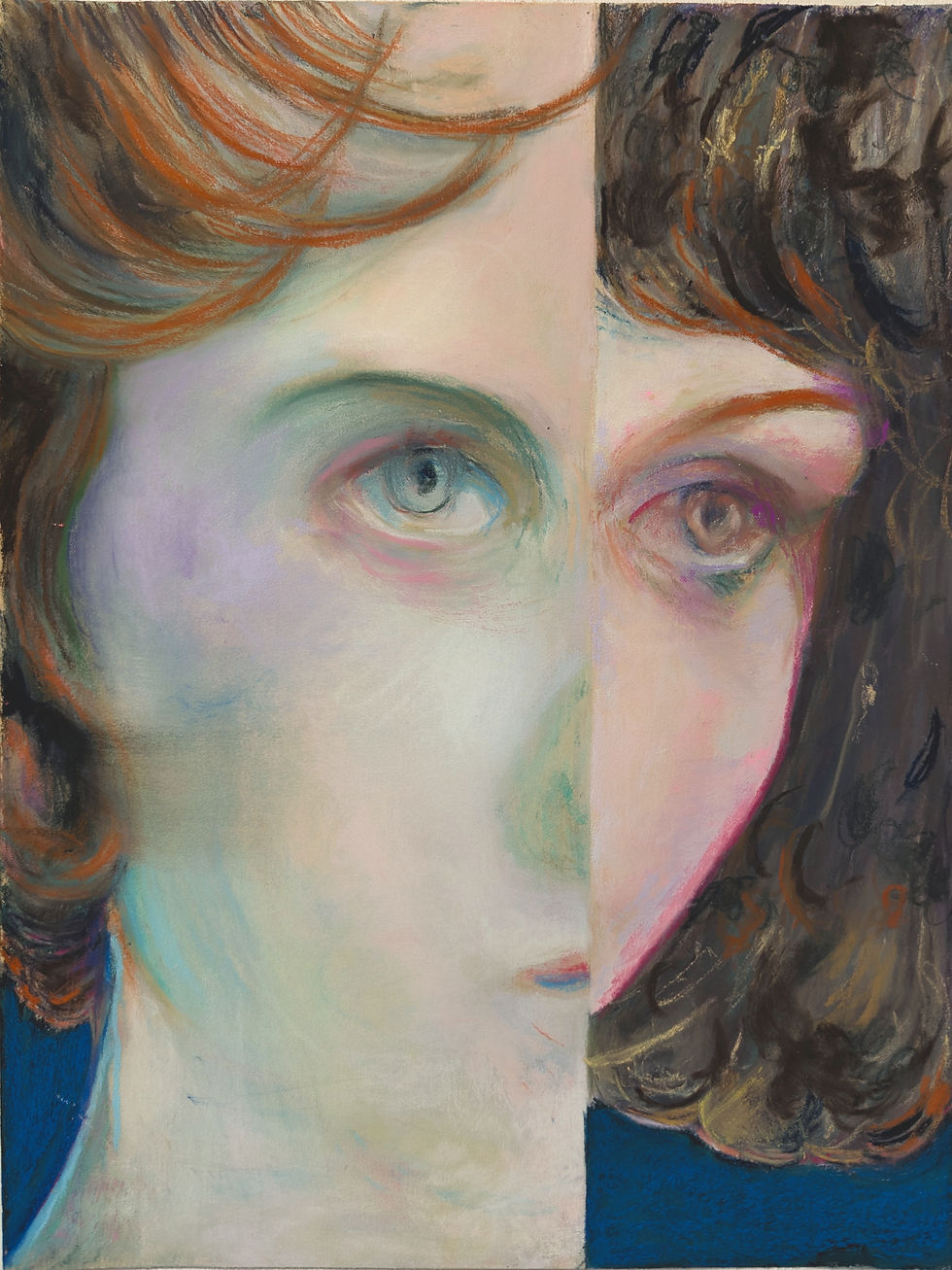
In Noah Saterstrom’s Scar, the very notion of a scar suggests that transformation leaves its traces: the wound may heal, but the body retains the memory of what it has endured; Ian Healy's portrait appears divided against itself. At a different scale, Gabriela Mendizábal’s abstract forms evoke a microscopic, cellular world, where matter seems to divide, reorganize, and continually regenerate.
What survives a metamorphosis—a likeness, a memory, the sensation of being oneself? These works suggest that identity is neither fixed nor entirely lost, but continually rewritten through the marks of what we have been..
The body remembers forms it can no longer inhabit.
EXPLORE THE WORKS →


To become is also to disappear.
04 /
What Hides
Absence is not the opposite of presence.
EXPLORE THE WORKS →


An empty room is never entirely empty. A face can be visible and remain unknowable. A body may appear before us while something of its presence quietly withdraws.
In The Poetics of Space, Gaston Bachelard approaches intimate spaces as repositories of memory, reverie, and imagination. Yet what remains hidden is not always concealed behind a wall or beneath a surface. Sometimes it resides in the distance between seeing and knowing.
The works gathered here inhabit that distance. They remind us that absence can be palpable, and that what escapes our gaze may be precisely what gives an image its haunting presence.
Not everything hidden is out of sight.
05 /
What Appears
And to appear is not necessarily to be revealed.
ALL IMAGES ARE CLICKABLE ↓

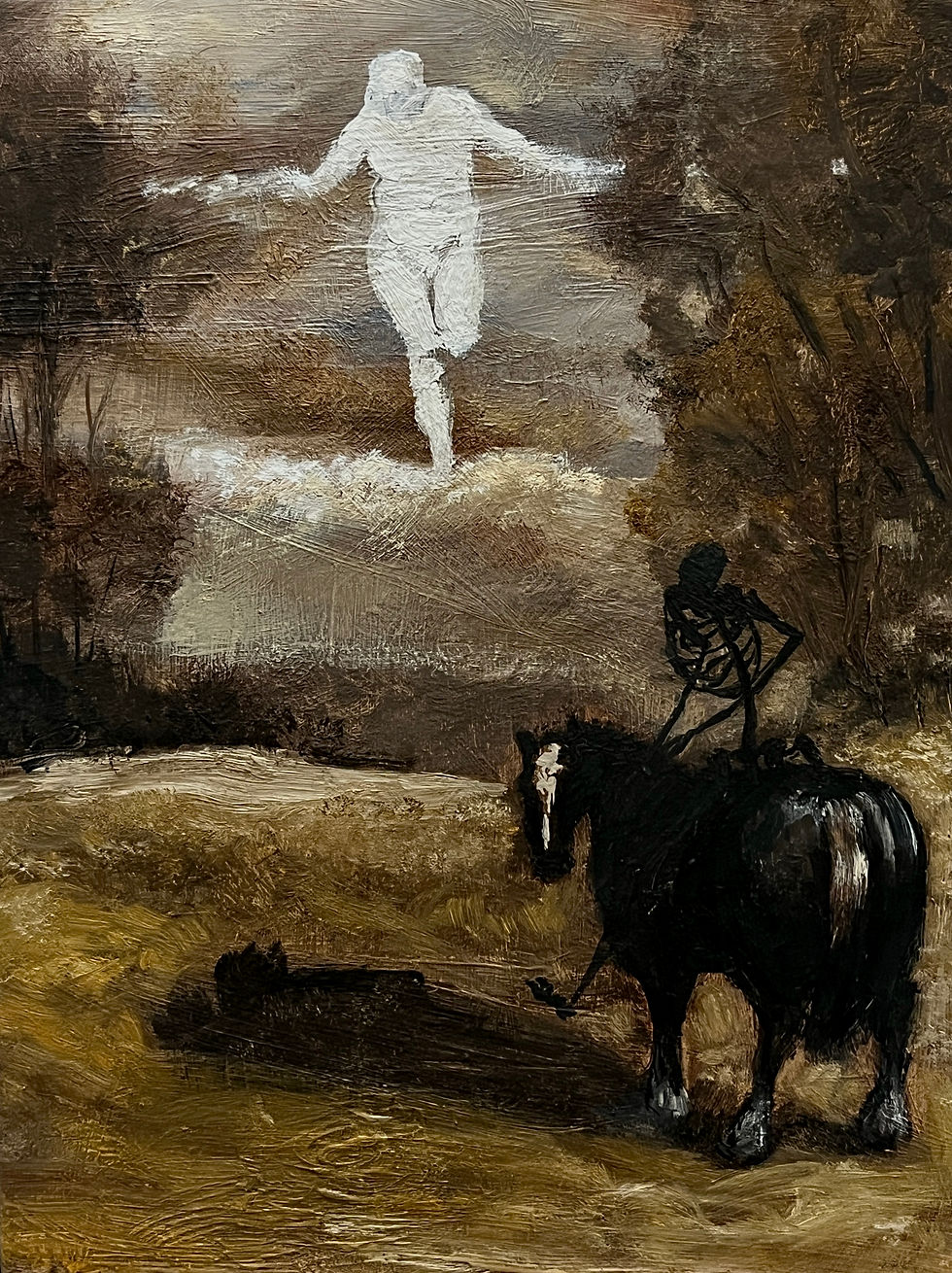


Perfection and the Pimple, 2025 Acrylic on canvas 50.8 × 40.6 cm (20 × 16 in)
Something emerges from the indistinct: a figure, a face, a presence that was not there before. Yet visibility offers no certainty.
From sacred visions to spectral portraits, the history of art is haunted by apparitions that resist explanation. In Maurice Merleau-Ponty’s reflections on the visible and the invisible, perception never exhausts what there is to know. What appears before us remains entangled with what escapes our sight.
These works inhabit that fragile threshold between manifestation and mystery. Perhaps an apparition does not reveal what was hidden, but makes us newly aware of the invisible.
06 /
What We Cannot Name
Not everything that exists can be named.
To name is to give the world an order. Yet language does not always contain what an image sets before us. As René Magritte explored, the relationship between an object, its image, and its name is never entirely secure.
ALL IMAGES ARE CLICKABLE ↓


Here, that uncertainty takes on a darker, more visceral form. Bodies resist classification, figures emerge from matter without fully separating from it, and the dead gather into a chorus of fractured identities. Elsewhere, a written question stops just as an answer seems possible. In a notebook, thought remains provisional, unfinished.

At this threshold, the unknown is not an absence to be corrected. It is a presence that asks to be encountered without the reassurance of a name.


Perhaps what we cannot name is what we have not yet become.